THEME:
How is architectural knowledge made? A little is constructed through explicit knowledge, rehearsed through other disciplines such as the humanities and sciences. Most, however, is constructed through tacit knowledge – through our personal knowledge of things we try and things we have experienced. To construct this knowledge we do all sorts of things – a range of poetic and practical acts where we try out our speculations and see if they have any traction. This is the faster way of constructing knowledge, yet there is another way, where ideas are tried and developed incrementally over generations, where the architecture starts to embody a knowledge of place, available materials, climatic and cultural conditions and an evolving skill base. This form of knowledge has been overlooked, partly through modernism’s romantic fantasy that architecture could be a (reductive) science but mainly through the development of industrial processes and transport systems where it is cheaper or more convenient to use ubiquitous products, whatever the situation. This year we would like to feed our creative, speculative and poetic inventions with the hard won knowledge that our forbears have accrued and embodied in their work over generations. We would like to see, without sentimentality, how a critical examination of old knowledge can nurture and play with new knowledge.
THEME IN RELATION TO THE PROGRAMME ANNUAL THEME:
This year’s theme is “transformative technologies”. To address this, we will explore the intersections between old and new knowledge, and the ways in which this is manifest in architectural and artistic practices. In addition to studying existing examples of the old and new, students are encouraged to be inventive in their explorations of a wide range of tools and technologies, embracing both digital and analogue modes of production.
STUDIO CULTURE:
Emma-Kate and Nat’s approach to teaching and research places an emphasis on experimental practices. In our experience an experimental approach fosters rich design potential while also providing a productive educational method that values what each student brings to the table. We value the way that working experimentally through materials and processes can open up possibilities that might elude us when working with more conventional design methods. We encourage speculative risk and not knowing where the idea will end. In studio 3b, we encourage each student to develop their own ideas and practices by helping them to discover or invent methods and media that resonate with their personal ideas and fascinations. This interest in the relationship between ideas and technique starts in a research project, where we encourage students to make their ideas as a reality that they can touch in such a way that provides a beneficial reflection on what they are doing. We see parallels between the care needed to embody ideas in real things with that needed to manifest ideas in representation and see both as a rehearsal for making ideas present in architecture. We therefore see the studies we ask students to pursue as analogous acts of architecture, where we care deeply about conceptual possibilities while caring just as much about the ways in which those possibilities can count through the way they might be made.
Throughout the year we encourage students to work in studio and to nurture a studio culture. Working in studio helps foster a collaborative working environment, where peer-to-peer learning takes place alongside more formal activities like tutorials, reviews, and workshops. For this to work, you will each need to set up your workspace so that it is a pleasant and productive place to work; and that you engage and support your fellow students in such a way that the conversations between you provide a rich and rewarding culture. We will collectively do our best to ensure that your wellbeing needs are well supported, in addition to your academic needs.
PROJECT 1 – PLAYING THE SITE:
Introduction
One of the thrills of architecture is the way it gathers so many individual ideas and attributes from so many disciplines in such a way that others can make sense of them. In Project 1 we will work analogically to rehearse at an individual level how you might want to make your ideas onto a site – your own creative and poetic leaps – and study how these ideas can be informed by older knowledge embodied in the site, local materials and conditions and the traditions of the sorts of things that you are making. At the same time we will see how these individual pieces and their performance can become part of a larger ecology with each other and with the place in which they are situated.
We will work analogically because when you look directly at the thing you want to do it is all too easy to look for solutions more than opportunities. We hope that by taking some aspects of the research out of the specifics of architecture but through things that have an analogic resonance, your ideas will flow more freely and without the burdens of architectural responsibility. Once your ideas are formed in this realm the pressures of translation into architecture are also lightened in that they will necessarily require poetic leaps that go beyond the lessons held in the research.
Project 1a
To introduce the project and help you find your interest in the work, in the first week we will ask you to study either an older example of vernacular architecture that is rich with embodied knowledge (relating to place, culture, skills, available materials and whatever else that architecture might negotiate) or a musical instrument that holds equivalent knowledge to the architecture. If you have the enthusiasm, you are welcome to examine both a building and an instrument. We will suggest examples yet you are welcome to introduce your own choices. We particularly recommend that you to visit the Royal College of Music Museum, the RAM Horniman Museum and the Musical Museum in Brentford. It is a very short project, but the greater the care you take in articulating what you have fond, the more you will learn. It is fine to present photographs and images of things you have examined. Any drawings should be analytical in a way that helps you understand the content (rather than illustrate or repeat what is already told in your photographs or other material). During these first few weeks, we urge you to keep an open mind, a good spirit and boundless inquisitiveness (to be sustained throughout the year!)
Project 1b
This initial design project asks you to develop a site-specific proposal for a site of your choice in Hastings, UK. We are asking you to project your ideas onto that site in a way that embodies both what you wish to bring to the place and a sensitivity to the knowledge already held in the place. This might include the acoustic properties of the location, its generative capacity, or the materials available at the site, for example. To achieve this, we will construct our own inventions of musical instruments that are specific to both your ideas and the site. During this warm-up project, you will identify the questions and fascinations that will develop into your individual research questions and methodologies for the remainder of the year.
Just as the range of buildings that make up a village or town make an individual and collective contribution to a place, these instruments will act in concert, and we will both survey and project onto our site through a performance of these instruments. We imagine that in the manufacture of these instruments you will play out combinations of old and new knowledge and technologies. We want to emphasise that we don’t require you to have any pre-existing skills as a maker or any musical training. However, we do expect you to be brave and ambitious with your proposals. The way you make the instruments might incorporate the most modern and traditional skills and techniques. We will help you develop the necessary skills.
This year we will not expect you to solve the world’s problems and do not to propose to address them head on – perhaps in reality the least likely method of achieving anything – but instead we will work more discursively and create an analogous realm in which to explore your ideas – a realm in which each of you have an individual presence yet also a collective responsibility and contribution to the work of others – our own ecology. Instead of proposing answers, we aim to help you develop a sensibility and sensitivity for how to address a place.
Our analogue to this larger ecology is the orchestra that plays a symphony, or perhaps a band that plays a song. Each is made up of a range of people with specialist skills (as instrumentalists) who play instruments made from available skills and materials. As we will discuss, the evolution of music is reciprocal with the architecture in which it has been played. We hope this analogous way of working will allow you to develop your ideas without the straitjacket that comes by framing architecture as a set of problems and solutions.
For the first term we expect that you will develop sustained and evolving research questions and the appropriate research methods to address those questions. You must also work speculatively so that you are developing questions through the work more than making answers to abstract questions (trust in the process!) You will also develop a sensibility for how your work has an impact on the place and the work of others and vice versa.
When developing your ideas, be mindful of how the way you design and create relates to the content at hand. This project is set up to help you develop a process and practice of working. Please document all the stages of this process and be analytical and critical of your observations, whether they are poetic or practical.
PROJECT 2 – COMPOSING THE COMMUNITY:
Project 2
We will use the same site for our architectural work, so that the musical performances work as a critical and poetic survey of the place, its given capacity and accrued knowledge, all in addition to the ideas you have projected on the site.
We will translate the lessons from our instruments into a spatial proposal for a small community in which the contingent connections with the place, circumstances, situation and larger ecologies are entertained by your architecture, along with your own contributions to the culture of the place. Alongside what has been learnt from the instruments, we will learn from the local building practices as well as promising current technologies or your own inventions when inventing our architecture. Each student will design a spatial proposal that, like the instruments, will work in concert with a place and with each other.
Your P1 instruments will be constructed as real, full size performing things, but your P2 spatial projects may have to exist through a combination of things that are full sized and represented at scale.
For the purposes of this brief, please excuse the over-simplification, but much of the old knowledge held in things is present figuratively and expresses itself in many forms. Modern disciplinary knowledge tends towards isolating and reducing ideas that can be expressed through abstraction (by removing those things from which the idea has been isolated). When we come to represent our work we will look at the traditions of both forms of representation and see how they can work together productively. We will also look at examples where the figurative has been used in scientific conversations and where poetry has been found in abstraction – how to take possession of these conventions. We will study this both in terms of the representation of knowledge through didactic objects and images as well as through the different ways in which abstraction and realism have been used to embody ideas.
We see this as timely moment to revisit such questions, as the ubiquity of photorealistic rendering techniques (which have fantastic potential) appears to be removing some of the critical and poetic potential of what the architectural drawing can discuss (in a lot of the work we see around us).As a development from Project 1, throughout Project 2 you will learn:
– How to divine the knowledge embodied in existing things.
– How to project your ideas onto a site and allow them to be nurtured by the condition of that place.
– The relationship between ideas and technique.
– How to engage in an active ecology, and how to – contribute and negotiate your place within that ecology.
– How old methods of making can meet new methods.
When working through research project, the difficult part for most students is to translate or transfer those ideas into architecture. Project 2 is an exercise in making that translation, so we are interested in seeing how you go about the process of evolving a spatial proposal that is nourished by your investigations in term 1. The focus is on developing processes and practices as opposed to providing solutions. We would therefore like to see many of the outcomes listed for Project 1 appear in your work for Project 2. We will value inventiveness, a tenacity to delve into your interests and rigour in evolving your working practice.
As with Project 1, we expect to see both an individual position appear in the work along with a sense of how that position relates to the work of others and the general ecology of the situation.
READING LIST:
Tactics for Not Knowing, Emma Cocker, in On Not Knowing, How Artists Think, Black Dog Publishing 2013
Lo-TEK Design by Radical Indigenism, Julie Watson, Taschen, 2020
Thinking Through Things – Theorising Artefacts Ethnographically, Amira Henare et al, Routledge, 2007
How Music Works, David Byrne, McSweeneys, 2012
TED talk. How Architecture Helped Music Evolve, David Byrne: LINK
My Cello, Tod Machover, in Evocative Objects, Ed. Sherry Turkle, MIT press, 2007
Site Specificity, Miwon Kwon, MIT press, 2002, LINK (open access)
Deep Listening, Pauline Oliveros, iUniverse, 2005
Thing Knowledge: A Philosophy of Scientific Instruments, David Baird, University of California Press, 2004
Architecture without architects, Bernard Rudofsky, University of New Mexico Press, 1987, LINK (to PDF)
IMAGE CREDIT:
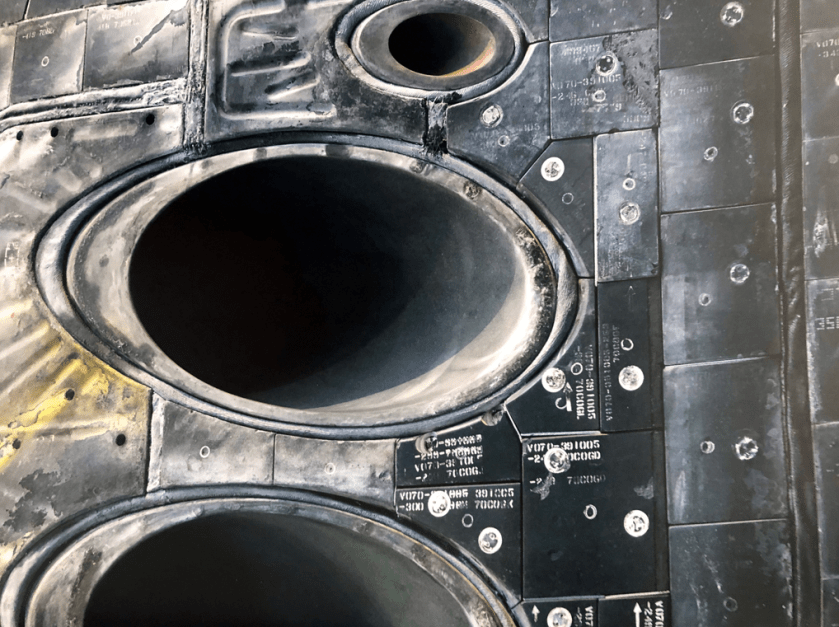
Nose Thrusters and TPS tiles on the Space Shuttle Endeavour, Tim Jones.
 X-STUDIO